
Prime Minister Narendra Modi is expected to visit Japan and China starting around August 29. The visit to China would be his first after the Ladakh border standoff.

China is set to build a rail link connecting Xinjiang province with Tibet, part of which will run near the Line of Actual Control (LAC) with India.

'The biggest point of contention is market access for US agricultural and dairy products.'

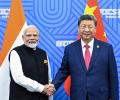
Prime Minister Narendra Modi and Chinese President Xi Jinping are expected to hold bilateral meetings on the sidelines of the SCO summit in Tianjin, as both nations look to strengthen ties amid global trade tensions.

New Delhi, while opting not to retaliate yet to the American tariffs, has in recent weeks sought to reinforce its friendship with Moscow, and recalibrate its ties with Beijing rather than surrender to Washington's diktats.

'We should watch -- in the near term -- for signs that the two have totally fallen out at a personal, political level.' 'Trump and Modi know how to be dealmakers, but they also know how to hold a grudge.'

India and Russia always stood "shoulder-to-shoulder" even in the most difficult situations, Prime Minister Narendra Modi told Russian President Vladimir Putin on Monday, against the backdrop of possibly the worst phase in New Delhi's ties with the US in over two decades.

The Global Times, a prominent state-run Chinese media outlet, published an article titled "China and India are cooperation partners, not rivals: Xi," highlighting President Xi Jinping's remarks about the bilateral meeting, saying, "as long as the two countries stick to this overarching direction, China-India relations can sustain steady and long-term growth."
'Geopolitically and diplomatically it's a very difficult situation for India.'

India would be represented by agriculture minister Sharad Pawar, who arrived in Moscow on Wednesday night on a three-day visit.
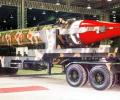
The US intelligence assessment highlights Pakistan's near-certain procurement of weapons of mass destruction-applicable goods from foreign suppliers, primarily through Chinese support.
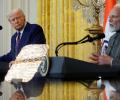
The deal fell through over unresolved disagreements over contentious issues, mainly on agriculture and automotive sector tariffs.
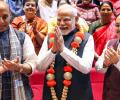
In his first address to National Democratic Alliance MPs in over a year, Prime Minister Narendra Modi on Tuesday emphasised its collective identity as a natural and organic alliance, asserting that its journey since its foundation in 1998 is dotted with successes and has many more achievements in store.
The Galwan clash occurred six months after the Doklam disengagement and two high-profile meetings. India should not be caught by surprise once again, asserts former foreign secretary Shyam Saran.

Embraer sees a lot of opportunities in India in the commercial and business jets as well as military aircraft and eVTOL segments, its CEO Francisco Gomes Neto has said as the Brazilian seeks to strengthen its foot print in the fast growing Indian market. Besides, the company is in talks with IndiGo and Air India to explore the possibility of selling its E-2 aircraft, which can have up to 146 seats.

'It is unrealistic to expect that security dilemmas and strategic distrust to disappear or even diminish any time soon,' says Rup Narayan Das.

The PM said there was a need to tackle the problem of terrorism in an organised manner.
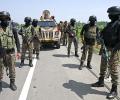
India needs to be technologically and militarily prepared to defend itself from both Pakistan and China, alerts Ramesh Menon.

'As the global economy undergoes significant transformations in 2025, India's ability to navigate the complexities of trade wars, financial realignments, and emerging blocs will be pivotal,' explain Harsh V Pant and Soumya Bhowmik.
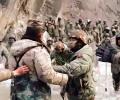
China has honored an army regiment commander who was injured in the Galwan Valley border clash with Indian soldiers in 2020 as an outstanding member of the national advisory body - Chinese People's Political Consultative Conference (CPPCC). Qi Fabao, who was made the torchbearer for the Winter Olympics in 2022, was among the 33 individuals honored with the 2024 Outstanding Performance Award for CPPCC Members. The incident, which resulted in the deaths of 20 Indian soldiers, led to a freeze in relations between the two countries for over four years. Ties were restored after a meeting between Prime Minister Narendra Modi and President Xi Jinping in October 2023.
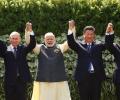
Narendra Modi's success at the BRICS summit is the best Diwali gift for India's diplomacy and marks her ascendancy to global leadership, says Tarun Vijay.

China appears determined to upgrade Pakistan's military capabilities, sufficient to ensure local parity with India, alerts former foreign secretary Ambassador Shyam Saran.
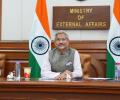
The BRICS stressed on resolution of conflicts in a declaration issued after a virtual meeting of foreign ministers of the member nations of the grouping. The meeting was attended by External Affairs Minister S Jaishankar and his Chinese counterpart Wang Yi.
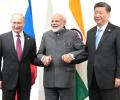
For the first time since the standoff between Indian and Chinese troops along the Line of Actual Control (LAC) in eastern Ladakh, Prime Minister Narendra Modi and Chinese President Xi Jinping are expected to come face-to-face virtually at the BRICS (Brazil-Russia-India-China-South Africa) annual summit to be held on November 17.
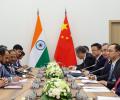
According to informed sources, Doval will arrive in Beijing on Tuesday to attend the crucial talks, which were expected to provide a way forward for the two countries to normalise the relations.

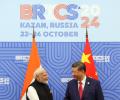
In the talks, Putin hoped that Prime Minister Narendra Modi will travel to Russia's Kazan next month to attend the annual BRICS summit.
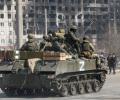
The Indian side is in "very close touch" with interlocutors in the foreign and defence ministries of Russia on the issue of Indians "who were, illegally or otherwise, contracted into fighting in the Russian Army", Misri said at a media briefing on Modi's visit to Russia for the BRICS Summit.

Noting that India has 'limitless possibilities and countless opportunities', Modi urged the BRICS business leaders to take advantage of them.
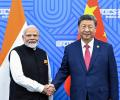
Prime Minister Narendra Modi has emphasized dialogue over discord in India's relationship with China, acknowledging natural differences between the two countries but stressing that stronger cooperation is essential for their mutual interests and global stability. In a podcast with Lex Fridman, Modi highlighted the ongoing efforts to restore normalcy along the border following the 2020 clashes, emphasizing the importance of a stable and cooperative relationship.
'Don't play the American game... India is too big for a US game.'

Both men spent most of their careers in their nations' intelligence services before they ascended to bigger roles -- Doval in the Intelligence Bureau; Putin in the KGB.
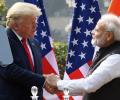
Prime Minister Narendra Modi and United States President Donald Trump on Monday vowed to work towards a 'trusted' partnership with a focus on boosting India-US cooperation in areas of trade, energy and defence in their first phone conversation since the American leader's inauguration last week.

The Congress and AAP said the logo looks like the party symbol of the Bharatiya Janata Party.

The five-nation grouping BRICS on Tuesday resolved to combat terrorism in all its forms and manifestations, including the cross-border movement of terrorists, and vowed to step up joint efforts in building support for an India-backed global framework to effectively deal with the menace.
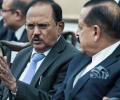
National Security Advisor Ajit Doval is likely to travel to Beijing within the next few weeks to lead the Indian delegation at a new edition of the Special Representatives dialogue on the larger boundary question that will be held after a gap of nearly five years, authoritative sources said.

PM stressed that 'response to terrorism must be nothing less than comprehensive'.

Both nations have to find ways to be sensitive to each other's politico-strategic and economic concerns, say Dr Rahul Mishra and Sana Hashmi.
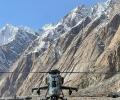
Defence sources stated that the disengagement involves removing infrastructure and withdrawing troops from both sides. The process is expected to be completed by Tuesday.

Russian President Vladimir Putin on Tuesday thanked Prime Minister Narendra Modi for trying to help find a peaceful solution to the Ukraine crisis.

Modi is also scheduled to hold a bilateral meeting with Xi on Tuesday.
